How to Write Landing Page Copy That Converts Paid Traffic
A conversion-focused landing page copywriting guide for PPC campaigns: message match, headlines, proof, CTAs, objections, and FAQ structure.
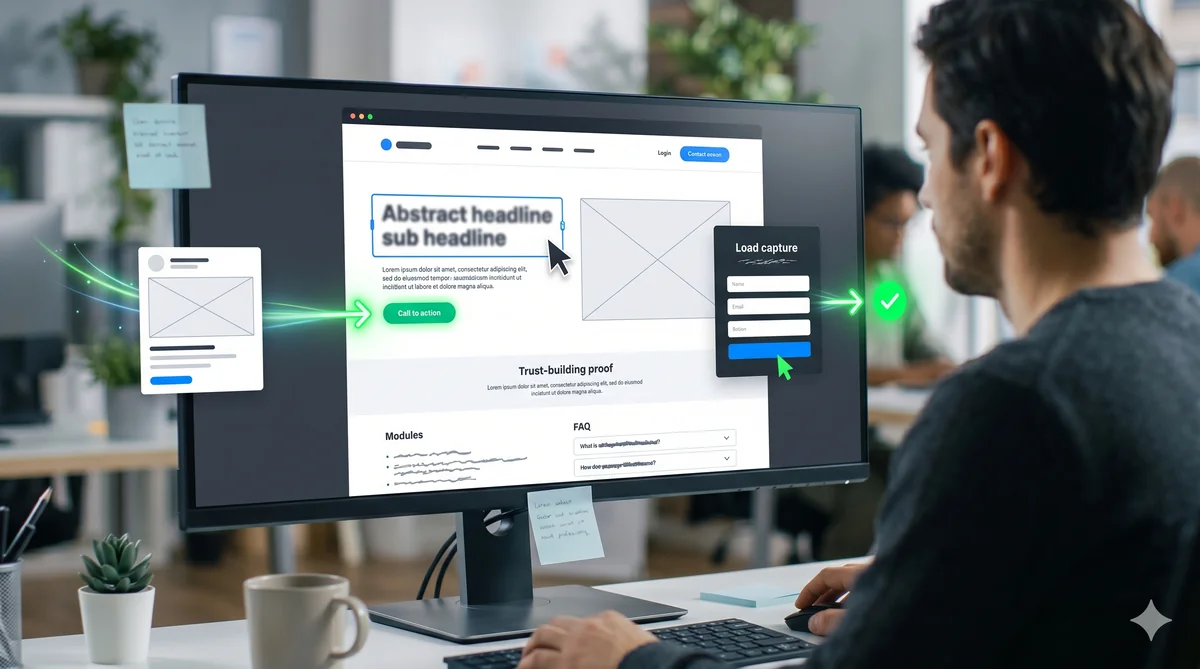
Conversion copy starts before the page
Landing page copy converts when it continues the conversation the visitor already started in search. The page should not introduce a completely new angle after the click. It should confirm the problem, repeat the promise, explain the offer, prove credibility, and make the next action feel safe.
For PPC, this is called message match. Better message match usually means less confusion and fewer wasted clicks.
Write the headline from the visitor's desired outcome
A good headline is not a slogan. It should say what the visitor can get or fix. Use the language of the search query when possible.
Weak: Grow your business with innovative solutions.
Stronger: Lower your Google Ads cost per lead with a dedicated landing page audit.
The stronger version names the channel, the metric, and the action. It gives the visitor a reason to keep reading.
Use the first paragraph to qualify the page
The first paragraph should answer three questions:
- Who is this for?
- What problem does it solve?
- What result can the visitor expect?
Example: If your Google Ads campaign is getting clicks but not enough qualified leads, the problem may not be the keywords. Your landing page may be creating friction after the click. Axerto helps PPC teams create focused campaign pages faster, so they can test offers without waiting weeks for design and development.
Replace features with decisions
Features matter, but copy should connect them to decisions. Do not only say fast page builder. Say launch a campaign-specific page before the next budget review. Do not only say analytics. Say see which page variant turns paid clicks into leads.
The reader should understand why each detail matters to their business.
Put proof near claims
Every strong claim needs support. If you say faster launch, explain the process. If you say better leads, show how the form qualifies prospects. If you say lower CPL, mention that results depend on traffic, offer, and follow-up quality.
Good proof can be a testimonial, short case snapshot, screenshot, checklist, certification, or process breakdown.
Write CTAs as next steps
CTA copy should reduce uncertainty. Try:
- Get my landing page audit
- Generate a campaign page
- Book a PPC page review
- See what to fix first
Avoid vague CTAs when the visitor is close to converting. Learn more can work earlier on a page, but the main CTA should be action-oriented.
Handle objections before the final CTA
Common objections for PPC landing pages include:
- Will this work for my industry?
- Do I need a developer?
- How long will it take?
- What happens after I submit the form?
- Can I use this with my current campaign?
Answer these in short FAQ blocks. Good FAQ copy can lift conversion because it removes hesitation without adding a sales call.
Final copy checklist
- The target keyword appears naturally, not mechanically.
- The headline matches the ad promise.
- The first paragraph confirms the visitor's problem.
- Each section moves toward one conversion action.
- Proof appears close to claims.
- CTA text describes the next step.
- FAQ answers real buying objections.
Copy that converts is specific, useful, and calm. It does not shout. It makes the right action feel obvious.
Build high-converting landing pages in seconds
Axerto generates complete landing pages from your Google Ads campaigns with AI.
Try Axerto Free